Sunday, April 19, 2015

Socrates in a Snapchat World

“We model an inquiring, probing mind by continually probing into the subject with questions.” (1)

In a perfect classroom with perfect students in a perfect world with a perfect teacher, Socratic Teaching is the perfect pedagogy. Teaching critical thinking through asking guided questions moves the teacher to the facilitator chair and puts the onus of thought and inquiry on the students. The Center for Educational Leadership’s “5D+ Self-Assessment and Professional Development Plan” insists that, in order for a teacher to be “distinguished” (which aligns with “highly effective”), they must do 40+ things, including the following 8:
  • The success criteria for the learning target(s) are clear to students. The performance tasks align to the success criteria.  Students refer to success criteria and use them for improvement.
  • Teacher sets expectation and provides support for a variety of engagement strategies and structures that facilitate participation and meaning making by students. All students have the opportunity to engage in quality talk. Routines are often student-led.
  • Teacher provides scaffolds and structures that are clearly related to and support the development of the targeted concepts and/or skills.  Students use scaffolds across tasks with similar demands.
  • Teacher consistently uses strategies for the purpose of gradually releasing responsibility to students to promote learning and independence.  Students expect to be self-reliant.
  • Students consistently assess their own learning in relation to the success criteria and can determine where they are in connection to the learning target.
  • Students consistently use assessment data to assess their own learning, determine learning goals and monitor progress over time.
  • Routines for discussion and collaborative work have been explicitly taught, are evident, and result in effective discourse related to the lesson purpose. Students independently use the routines during the lesson. Students are held accountable for their work, take ownership for their learning and support the learning of others.
  • All available time is maximized in service of learning. Transitions are student-managed, efficient, and maximize instructional time. (2)

These 8 items on the rubric require the students to: lead the class, monitor themselves, assess their own progress, set their own goals, and “take ownership for their learning and support the learning of others.” And herein lies part of the problem with this specific teacher evaluation rubric; it's also part of the problem with Socratic teaching: it asks the students to do things that students (and most adults) aren’t really that interested in doing. Let’s face it: we want to find the shortest, fastest path to the correct answer, so that we can get back to our lives. LOLcats are decidedly more fun than formulating answers to guiding questions; in a Snapchat world, we want to find and send the right answer in 6 seconds or less.

My research project is fundamentally based on Socratic Teaching. Instead of giving students a checklist of criteria that their sources must pass in order to be deemed “good,” I am asking them guiding questions, and demanding that they think critically about the information and formulate their own guidelines to determine source reliability. Right now, my students are crashing and burning. They treat the Internet like a scavenger hunt: click quickly, skim for information, copy it down, move on to the next question. I am fundamentally challenging the way they do research on the Internet (and maybe even the way they do school), and they are frustrated by the lack of “answers” that they find.

A 2011 study(3) in which a Socratic lesson was re-enacted with modern students found that students “gave answers astonishingly similar to those offered by Socrates’ pupil”(4); however, more than half of the contemporary subjects failed to understand the importance of the questions themselves. This study raises questions about the Socratic method and students today. In a world that moves as quickly as ours, where the right answer is the celebrated one, and the bubble sheet is the final dictate of success, is Socratic teaching even truly possible? Can students truly learn critical thinking by being presented guided questions, and is that method truly valuable to them and to their lives?

I would answer, resoundingly... “maybe?” 


__________________________________________________________________

(1) Foundation for Critical Thinking. “Socratic Teaching,” 2013. Online. Internet. 19 Apr. 2015. . Available: http://www.criticalthinking.org/pages/socratic-teaching/606.

(2) “5D+ Teacher Evaluation Rubric,” n.d. Online. Internet. 19 Apr. 2015. . Available: http://info.k-12leadership.org/5d-teacher-evaluation-rubric.

(3)  Goldin, A. P., Pezzatti, L., Battro, A. M. and Sigman, M. (2011), From Ancient Greece to Modern Education: Universality and Lack of Generalization of the Socratic Dialogue. Mind, Brain, and Education, 5: 180–185. doi: 10.1111/j.1751-228X.2011.01126.x.

(4) Paul, Annie Murphy. “Why Asking Questions Might Not Be the Best Way to Teach.” Time, n.d. Online. Internet. 19 Apr. 2015. . Available: http://ideas.time.com/2011/12/14/why-asking-questions-might-not-be-the-best-way-to-teach/

“research cat says Wikipedia not acceptable source - Cheezburger,” n.d. Online. Internet. 19 Apr. 2015. . Available: http://cheezburger.com/1959160576.
 

Enmeshed in a World Wide Web of Frightening Metaphors

“Can you trust everything you read on the Internet? Can you trust anything you read on the Internet? Teach your kids which Web sites to trust!”(1)
 The sub-headline on Education World’s lesson plan page for teaching web literacy shouts at us with bold and italics. The subtext is clear: the Internet is a place you cannot trust. Education World goes on to list the possible authors of web pages, including “any ignoramus -- or satirist or bigot or fool with an ax to grind” and presents the scary question: “how do kids distinguish between The WhiteHouse.org (a site you definitely don't want to show your students) and The WhiteHouse.gov?” [For those not in the know, WhiteHouse.org is a political satire site, mostly mocking George W. Bush and many policies from his tenure as president, but has also had adult humor and adult content links from time to time; it includes the hilarious and inappropriate “White House for Kids” page of links on fun tobacco safety, how to deal with stupid policemen, and abstinence (how to keep it in your pants). This site is not to be confused with WhiteHouse.com, which was a porn site for years, before it turned into a list of dating site links and now seems to be mostly defunct.]
This positioning of the Internet as a place full of ax-grinding predators lying in wait to trap children into smoking cigarettes and running from the police is not limited only to poorly constructed arguments complete with bandwagoning and a lack of concrete evidence by sites such as Education World, who claims “The words you are reading now have been read -- and reread -- by several experienced editors and educators. They are words you can trust -- posted at a site you can trust”; this us-versus-the-monster language is a consistent feature of the media literacy discussion.


 The European Association for Viewers Interests (EAVI) video series (2) on media literacy for children (written by Paolo Celot and Susie Jones) features Jack, a small boy in a rowboat navigating an ocean. On his journey through the waters of the Internet, Jack sees a submarine spying on him, sharks circling his rowboat, an armada of pirates meant to represent advertising, and a single octopus’ tentacle that suddenly rears up out of the water, towering over Jack, meant to represent false advertising and the hidden danger trying to pull Jack under or capsize his rowboat at any time. Lurking under the surface of the water, there is a submarine with a bomb, more sharks, and some sort of big-toothed piranha-like fish, representing google searches. The narrator of the video points out that Jack must be “armed with critical thought,” a metaphor that escalates the dangers lying in wait to attack Jack to that of a war, in which he needs weapons. In episode 2 of the video series, Jack lands on an island, and promptly “gives away his power” and “allows the media to distract him”; the viewer watches a scary cartoon of Jack in his boat getting dragged all over the place in the ocean by a submerged arm. Lux, the aptly named guide for Jack, appears and tells Jack he must “nurture the seed of awareness in [his] belly” so that it can grow into an awareness tree. Jack then climbs his tree of awareness and texts his friends, sadly circling the base of the tree down in the darkness of the forest, so that they can ask themselves “What am I doing? Where am I going?” and find their own awareness tree to climb and giant bird to ride through the sunny air of the Internet.

The metaphorical world of the media that Andrea Quijada constructs (3) is no more mature and no less frightening than the world of ignoramuses, satirists, bigots, and fools with axes to grind, or the world full of circling sharks, tentacles, submarines, and pirates, all wanting to ambush or capsize Jack in his rowboat. Quijada’s world presents an Internet full of subtext and untold stories; her media literacy students are on a quest to deconstruct the media; they need magical “accessories” in their toolbelts. She likens the media-literate student to Wonder Woman with a “golden lasso”; her students, when finished with the media literacy unit she teaches, have “gained a superpower.” Her prevalent example of media manipulation and the deconstruction of the message is an ad by a credit card company that her winning student deconstructed and reconstructed, to show the “corporate manipulation and slavery” that the subtext of the ad was selling.

These scary metaphors are doing more harm than good. Media literacy skills are critical, and teaching students (and ourselves) to be critical thinkers is incredibly important...but not because the sharks are grinding their axes and we can only survive by using our golden lasso to avoid smoking the abstinence cigarettes of corporate manipulation and slavery. We should teach students to use critical thinking because that’s what educated people do. If we approach the Internet tentatively out of fear, waiting to see what lurks around the corner to pounce, we risk missing the chance to be on a level playing field, participating as savvy consumers, creative inventors, and eager explorers.

If there is a war to be fought, it should be with our own fear; our students should be armed against ignorance, assumptions, and malevolence in all aspects of their world...and mind. 


 _____________________________________________________________________
(1) Education World. “*I Read It on the Internet: Teaching About Web Literacy,” 13 Jan. 2015. Online. Internet. 22 Mar. 2015. . Available: http://www.educationworld.com/a_lesson/lesson230.shtml.

(2)  Media Literacy Concepts and Metaphors: Critical Thinking, 2013. Online. Internet. 19 Apr. 2015. . Available: https://www.youtube.com/watch?v=BYKnfuFZ1pA&feature=youtube_gdata_player.

(3) Creating critical thinkers through media literacy: Andrea Quijada at TEDxABQED, 2013. Online. Internet. 19 Apr. 2015. . Available: https://www.youtube.com/watch?v=aHAApvHZ6XE&feature=youtube_gdata_player.
 
 All images licensed through Creative Commons for public use. 

Monday, March 30, 2015

Teacher in a Strange Land

In “Teaching the Digital Native: Learning With Computers and the Internet Poses New Challenges,” Fawn Johnson, reporter for NationalJournal.com, writes about the changing landscape in the education industry, and the need for schools, teachers, and infrastructure to evolve with the times. Although she attempts to write from a pro-education standpoint, her premise is clear: the computer programs are good, and the way teachers have been teaching and schools have been running is bad.

Photo by Sean Gallup/Getty Images.

The picture above, included with the article, is captioned: “Digital classrooms are the wave of the future.” Notice the very homogenous classroom with their matching brown shirts. Is this how our students look? Is this the student body of the future? Who is the audience for this article, if their vision of the classroom is white kids in matching T-shirts? 

 It is important to note that National Journal, according to Wikipedia, receives “substantial financial support from the Gates Foundation ($240,000+) to provide coverage of education-related issues that are of interest to the Gates Foundation.” That may help to explain Johnson’s stance, and even her audience. She is not talking to educators or parents; she is preaching to the corporate company choir.

Johnson cites two recent “experiments” in which a school district implemented new technology. The first experiment, one she labels a success, was Kramer Middle School in Washington D.C. The principal, Kwame Simmons, installed state-of-the-art infrastructure into his newly remodeled building, instituted blended learning (half of the students’ time is spent on laptops, and the other half is teacher-led), and replaced “most of the teaching staff so he could hire technically savvy faculty.”

The second experiment, nationally deemed a failure, was the Los Angeles school district’s disastrous $1Billion iPad purchase without the necessary “comprehensive implementation plan.” According to Johnson, “schools paid full price for online curriculum that wasn't finished, students complained that they couldn't read on the iPad screen, while others figured out how to bypass the Internet controls and surf the Web for anything. The school district suspended the program."

Looking at the Kramer Middle School experiment, a school that “replaced” (a very pretty way to describe a systematically firing of the staff and a hiring of a brand new staff) most of their staff to hire “tech savvy faculty” (note that she didn’t say teachers), it is easy to take her word on this success story. And yet, Johnson doesn’t link to any articles throughout the Kramer paragraphs, although she links to articles everywhere else. In my own research, I have found that, although Simmons’ picture and profile are listed on the Kramer Middle School website, Delia Davis-Dykes is listed as interim principal at the District of Columbia Public Schools’ website. The Kramer Middle School Facebook page has not been updated since 2011; KMS is rated 2/10 on greatschools.org, 12th out of 13 ranked schools on schooldigger.com, and is a Priority school based on 2013-2014 data. It is extremely odd that Johnson, in her article published September 15, 2014 deems Kramer Middle School as a success and Simmons as a visionary.

Putting aside the questionable journalism of this article, it does speak to the bizarre time we, as teachers, are currently in. The “digital native” language in and of itself is troublesome, as it is imbedded with so much emotional and social weight (and is no longer politically correct). But the concept that the teachers in the “successful” district had to be replaced in order to present this technology-rich success story is also disconcerting.  According to Johnson, “Only 8 percent of teachers say they feel proficient with technology, according to White House data,” although she does not link to this study or cite a source for this statistic.

Johnson fawns about a forum held by The Atlantic in 2014 that “featured some of the most prominent innovators in education technology, the people who design individualized learning platforms and free online courses and ways to take and share notes on online content. It's wonderful stuff as long as there are people and resources to make it work like it's supposed to,” she concludes. You will notice that she talks about “it” working. And the people and resources that need to be there in order for “it” to work. What is “it”? Well, I can tell you what it is not. It is not nurturing. It is not student-centric. It is not building relationships with students. It is not making personal connections with students’ lives and helping them see how to not only survive in this world, but to thrive, and maybe even to make it better. It is not a human connection. It is a computer program, built with algorithms, sold to districts, who then need to replace their content-expert and student-expert teachers with technology experts.

The statistic that “only 8 percent of teachers say they feel proficient with technology” tells us something very truthful about teachers, but it’s not what Johnson thinks. Her premise is that, if teachers say they aren’t proficient, then they must not be; therefore, they should be replaced with faculty who are proficient in technology. Whether or not this statistic is real (and there is no evidence in this article that the statistic IS real), teachers do say they don’t feel proficient. Why? Because teachers believe that they have to be experts in their field. In order to be an English teacher, I have to be an expert in English language and literature. Teachers are highly trained and highly proficient in their content area, and their content area is not technology, unless they happen to be a technology teacher.

But do teachers have to be experts in technology in order to remain relevant in teaching? In “The Deconstruction of the K-12 Teacher” Michael Godsey, longtime English educator, mourns that teachers won’t be relevant for much longer. He voices his fears that teachers are no longer allowed to be the experts in their subject area; instead, teachers have to be “expert facilitators.” They have to be able to manage multi-modal and blended-learning educational programming: in essence, pre-packed, canned curriculum. They are no longer teaching, but rather “facilitating,” while the computer programs do the teaching.

This goes against everything teachers have been trained to do...and against the driving philosophies that teachers idealistically believe in, when they go into education. They want to work with kids: to inspire, to challenge, to help, to teach. They don’t go into teaching to manage computer programs and hardware. Teachers do not deem themselves “proficient in technology” because, to be proficient, in educational terms, is to be at mastery. By very definition in the classroom,  a proficient teacher is a very good one. And we are charged to raise all of our students to proficiency in our content area. That means that all of our students are “at mastery” of the content. And teachers do not feel like they are “at mastery” in technology.

What teachers are proficient in, is teaching the individual human students in their classroom, with all of the baggage and hopes and struggles and dreams that students bring. And this is something that no computer algorithm can do, no matter how many “success stories” are written by the corporate mouthpieces.


"...she's all the unsung heroes who couldn't make it but never quit." 

________________________________________________________________________________

“Auguste Rodin, ‘The Fallen Caryatid Carrying her Stone’ c.1880–1, cast 1950.” Tate, n.d. Online. Internet. 30 Mar. 2015. . Available: http://www.tate.org.uk/art/artworks/rodin-the-fallen-caryatid-carrying-her-stone-n05955.

Heinlein, Robert A. Stranger in a Strange Land. Penguin, 1987.

Monday, March 9, 2015

How do you solve a problem like Wikipedia?


She is gentle! She is wild!
She's a riddle! She's a child!
She's a headache! She's an angel!

She's a girl! (1)

Actually, Wikipedia is not a girl. A 2011 survey by Wikimedia (cited by Laura Goldstein in her article, "Mass Wikipedia Edit To Make The Internet Less Sexist") found that “less than 8.5% of Wikipedia contributors were female.” Wikipedia itself claims to that women make up 13% of the editing community. Wikipedia, in fact, has a girl problem. 

She’s a headache. 

Specifically, Wikipedia has a problem with the shockingly low numbers of female editors, female entries, and the classification of women in the arts. Amanda Filipiacchi, in a 2013 op-ed for The New York Times, uncovered an ongoing classification problem whereby women authors were systematically being moved from the “American Novelists” page to the “American Female Novelists” page. As Filipiacchi points out, this practice of creating a sub-category will lessen the chances of those moved to the American Female Novelist page of showing up in a general search. This subjugates not only the information about these authors but the authors themselves.

She’s a riddle. Or is she an angel?

Often maligned and discredited by teachers across the United States as being “unreliable,” Wikipedia is also revered by those who understand that open-sourcing provides a huge base of information that is constantly being edited in real time, allowing for the most accurate and timely publication. And yet, even Wikipedia doesn’t want to be known as “open-source.” A decade ago, Daniel Terdiman wrote "Wikipedia’s Open Source Label Conundrum" for cnet.com, and the confusion still stands. Is Wikipedia a free-for-all? Or is it highly reputable? Does the allowance for anonymity of authorship and edits create a meritocracy? Or does it allow for trolling and for edits of a disreputable nature and intention?

She is wild.

After Filipiacchi wrote her piece in 2013, there were numerous edits to her Wikipedia page, sabotaging her information. Although most of the edits were done by one person or a small group of people, their anonymity protected them from any backlash. In essence, Filipiacchi was bullied for simply noticing and writing about the sub-categorization of female authors. The Wikimedia Foundation takes no ownership or control of content. According to Martha Nichols and Lorraine Berry, in their article, "What Should We Do About Wikipedia," "The Foundation estimates that there are about 80,000 active editors (those who make at least five edits a week) for all the Wikipedias around the world...With the exception of removing a very small number of articles or posts that might violate copyright or potentially harm someone, [the Foundation does] not remove or alter content. That’s all in the hands of [the] volunteers.” In essence, there is very little oversight. The system relies on the common good of the group to edit for good, not evil. And some would argue that the edit history would allow users to discriminate between good and bad information; but this is assuming that the average user would be savvy enough to check the history and understand its implications. Part of the issue IS the average user: one who would never search sub-categories for information and therefore would miss out on all of the content that has been sub-categorized.

She’s a child.

Nichols and Berry point out that this issue is just the tip of the iceberg. The authorship of Wikipedia skews just as heavily to certain demographics as it is heavily male. Pages written about minority subjects are often sub-categorized, institutionalizing the social and political imbalances present in our society into Wikipedia’s entries. Wikipedia’s foundational beliefs supporting free authorship are idealistic and simplistic in a world governed by race, money, gender, and class. It’s immature to believe that the system will govern itself, if the dominant voices in the system are of the dominant group.

She is gentle...

One response to this issue of the sub-categorization of women on Wikipedia, and of the glaringly low female authorship of Wikipedia pages is the The Art+Feminism Wikipedia Edit-a-thon,sponsored by MoMA and held on International Women’s Day. According to Jennifer Schuessler, writing for The New York Times’ Arts Beat,“Last year’s event, which drew participants in six countries, resulted in more 100 new articles on female artists, feminist artistic movements and feminist scholarship and improvements to more than 90 articles.” This year, the event has the same hopes and is held across the globe at more than 70 sites worldwide. Although this event is not a traffic-stopping march, it is an educated and calculated attempt to meet Wikipedia on its terms and strive to make it better.

So, how do we solve a problem like Wikipedia?

Events like the Art+Feminism Wikipedia Edit-a-Thon are one solution. If those groups disenfranchised by Wikipedia add their voices and their pages and move their subjects into primary categories, their subjugation by sub-categorization will subside. It is time for all voices to be represented by Wikipedia; the only way for that to occur is if those very voices demand to be heard.

Goldstein states, “In the 21st century, when women have unprecedented freedoms, they are still marginalized, not just in the art world, but also on the digital plane, often relegated to a footnote or brief citation. While we’re still a distance from common-sense realities like equal pay for women, comprehensive childcare, and a reproductive rights bill, at least the digital world will be a slightly more female-friendly place after this weekend.”

Wikipedia needs not only to be a girl; it needs to be a boy and everything in between; it needs to be all genders and without gender; it needs to be all races, and yet blind to race. It needs to be the egalitarian database that its very premise sets it out to be.


____________________________________________________________________________________________________
          (1) Rodgers, Richard, and Oscar Hammerstein II. "Maria." The Sound of Music. 1959. 

“Wikipedia:Wikipedia logos.” Wikipedia, the free encyclopedia, 4 Feb. 2015. Online. Internet. 30 Mar. 2015. . Available: http://en.wikipedia.org/w/index.php?title=Wikipedia:Wikipedia_logos&oldid=645650101.
 
Zywalewski, Dariusz. “The first Wikipedia Monument in the world • Collegium Polonicum.” Text, n.d. Online. Internet. 30 Mar. 2015. . Available: http://www.cp.edu.pl/en/public_relations/startsite_news/spalte_4_oben/wikipedia/pomnik-wikipedii/index.html.


Friday, February 27, 2015

A Robot by any Other Name...


...would still write for the Associated Press


Will Oremus, Slate’s senior technology writer, unpacks the idea of “automated journalism” in “Why Robot?

“The Associated Press has been publishing corporate earnings reports written entirely by computer programs,” he states.

The primary focus of his piece is on the naming of the technology, and the different connotations that are presented with each name. He pushes back against the word “robot” as used by many writers he respects, writers who have written about robot journalists, robot-writing, and articles written by a robot.

“If I were a “robot” journalist,” he says,” I would deftly fill the rest of this post with updated facts and numbers describing the scope and pace of robo-journalism. Instead, my quixotic human brain has led me to focus on a question of semantics: Are the computer programs that are writing the AP’s news stories really robots? And if not, why do even the most careful of writers keep calling them that?”

Obviously, we are to understand that Oremus, himself, is clearly not a robot. His use of the allusion to Don Quixote in his naming of his own brain identifies him as truly human, and full of the idealism, sentimentality, irrationality, and impracticality that separates the human from the machine. Oremus then sets out to idealistically, rationally, and practically (without sentimentality) analyze what this writing technology should be named, and why so many people are insisting on naming it what it is not.

Robbie Allen, the CEO of Automated Insights (the company behind this writing technology), calls it “software.” “It’s funny,” he says… “I mean, they know it’s all software, right?”

And yet Automated Insights has released the following video, clearly understanding in their PR department that this concept of “robot” is alive and kicking.


Oremus goes on to define for us what a robot truly is, including the history of the word and the current definitions of the word. He tells us that the word robot comes from the Czech word robota, meaning “forced labor.” It is “A machine capable of carrying out a complex series of actions automatically, especially one programmable by a computer.”

This article-writing program is not a machine, clearly. Therefore, it is logically not a robot. So what is it? Oremus asks leading industry experts for a better name.

Chris Anderson, co-founder and CEO of 3D Robotics and former editor-in-chief of Wired names this writing technology a bot: a software application that runs automated tasks over the Internet.

The chief technology officer for iRobot (maker of the Roomba) names it a software agent.

Kris Hammond, chief scientist at Narrative Science, names it “artificial intelligence platform.”

So Oremus goes back to Allen at Automated Insights and pushes for a better name. Allen comes up with “Automated Insights’ Wordsmith platform”...or...“a natural-language generation platform called Wordsmith.”

Oremus and Allen haggle it out and finally decide on the word software. “Software is writing AP stories,” Oremus finally declares.

So why, he asks, is everyone calling it a robot? What is it about this technology that makes us want to name it something other than software? His answer is two-fold. First, the name “robot” makes us click the link. When writers have to get readers, they have to get the readers to click; they get paid by the click. We all know what software is, and software is not sexy. It doesn’t get our heart racing. But a robot: a robot is an entity. And this is the second part of his answer. “The term carries a lot of pop-cultural baggage,” he states. His personification of the term, allowing it to carry emotional baggage, makes it an entity, just a little too close to being human.

In addition, the idea of a robot as an entity that can do what we humans do heightens the drama of us versus them. Robots will take our jobs. Robots will replace us. Robots will malfunction in some sort of Maximum Overdrive dystopia.

Oremus ends his piece juxtaposing the idea that this writing software has not, in fact, created a reduction in human staff at the Associated Press, but has opened up the writers to more creative projects, leaving the boring stuff to the software; and yet, he reminds us, we must be prepared for the change, for the elimination of jobs, and for the eventual rewriting of our roles.

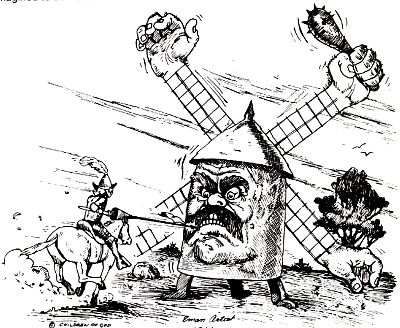
Oremus’ insistence on finding an accurate and rational name for the AP writing software belies his warning at the end. He is, in fact, quixotic, both tilting at the robot windmill and simultaneously arguing that the windmill is simply misnamed. It seems that he has missed the point in using the obvious reference in the title of his piece “Why, Robot” to I, Robot, the Isaac Asimov short story collection. Asimov’s Three Laws state:
  1. A robot may not injure a human being or, through inaction, allow a human being to come to harm.
  2. A robot must obey the orders given it by human beings, except where such orders would conflict with the First Law.
  3. A robot must protect its own existence as long as such protection does not conflict with the First or Second Law.

The naming of the technology may lessen or heighten our human emotional reactions to it; but the creation, control, and ethical use of the technology is and will continue to be up to the human beings who live with it.